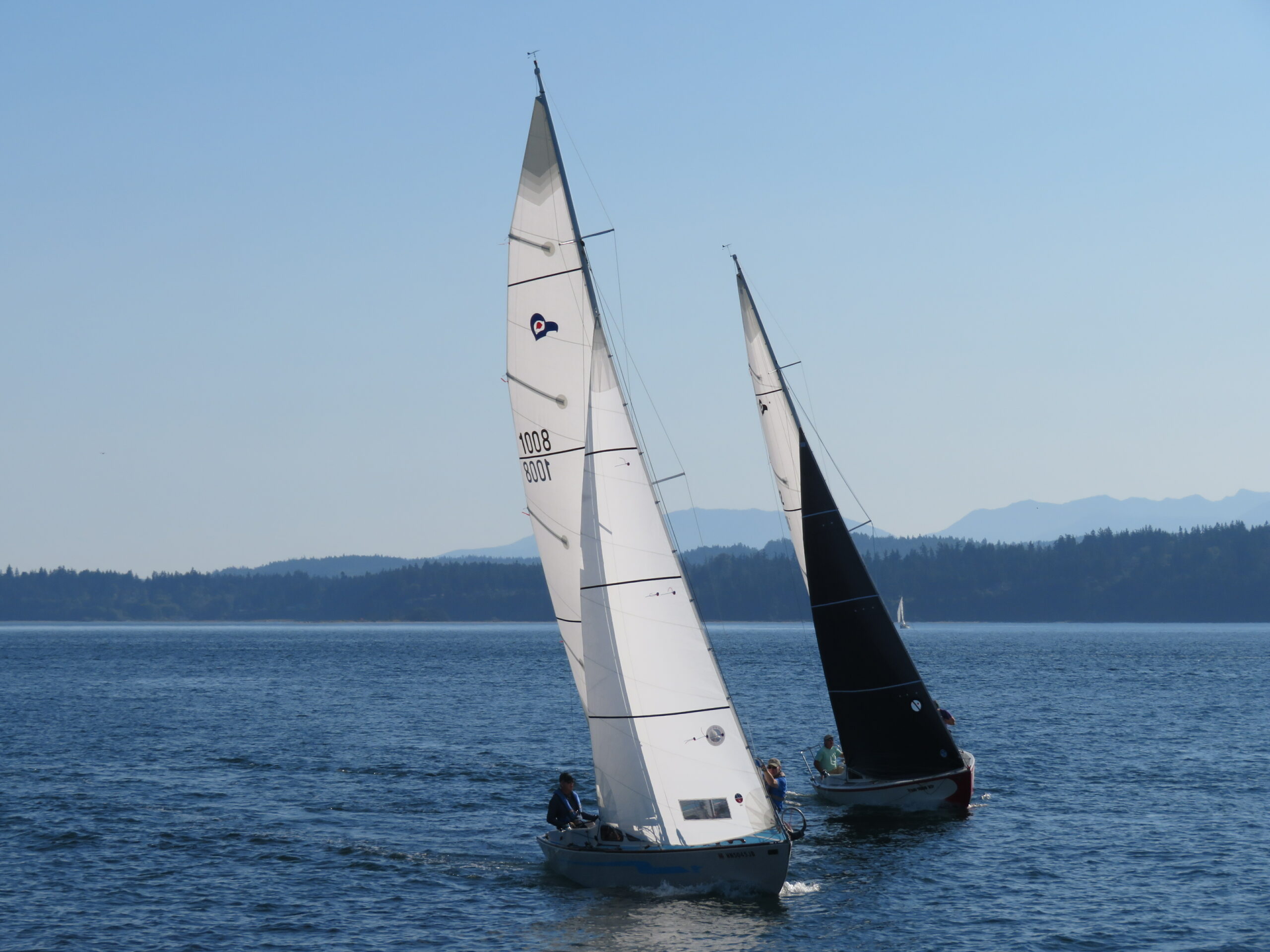
Learned Thursday afternoon that this weekend the Thunderbird class regionals will be on the Bay. Racing is scheduled from 10 - 4 on Saturday, and 10 - 3 on Sunday.
The rumor is that Thatuna and Boreas are the only PT boats participating. Sail fast.
If the next America’s Cup is sailed in catamarans with hard wing sails, this could be a dress rehearsal. Video comes complete with fast boats, scenes of damage and destruction, annoying music, and rough language. What more could you want? Lifted from Sailing Anarchy.
Take a look around the docks and it’s clear that the Wooden Boat Festival is around the corner. There’s lots of last minute work going on to get already well tended boats even better tended. In that spirit, here’s a short item on cleaning your varnish brush from the blog Windborne in Puget Sound.
Clean thoroughly and store in the freezer.
Good varnishing brushes are definitely not cheap! The quickest way to ruin one is to let varnish dry in the brush – not something any of us wants to do.
But cleaning a brush is not an easy task. You may think that after triple-rinsing it in fresh paint thinner, the brush is clean. But put it away for a couple of days, and when you go to use it next, the bristles are disappointingly stiff.
As a Chemical Engineer, I learned several things that have made brush cleaning a lot easier. (What? Practical knowledge? Who knew?):
We pulled into the waiting line at the Kingston ferry and through the fog I saw an unexpected sight – an old flat bed truck with what appeared to be a Jensen Healey struggling to stay on board. A Jensen Healey? On a flat bed truck? So I wandered over. I didn’t get the whole story but the gist of it was that for $300 cash money this historic pile of rust, whitworth (or maybe just metric) bolts, dreams and unlimited potential, fresh from being excavated from the salal could be mine. One voice in my head raised from a youth spent reading Road & Track started telling me “this is an unbelievable deal, buy it.” The other voice whispered in my other ear that this will be the easiest of the $300’s you’ll spend on this one. Look at the rust on the axles and bottom trunk panel. Why do you think it was parked in the first place? So feeling good I could still identify a Jensen Healey in the fog, walked away.
What was it like to see salmon so thick in the rivers
you could “smell them blocks away”?
What seafoods were harvested on the beach?
What was it like during the heyday
of fishing on the Strait of Juan de Fuca?
“Voices of the Strait”, a documentary by Al Bergstein interviewing people who have lived out here on the Peninsula over the last 50 years will be shown on August 26th 7:30 PM – PT Marine Science Center – On the beach at Fort Worden – Admission Free.
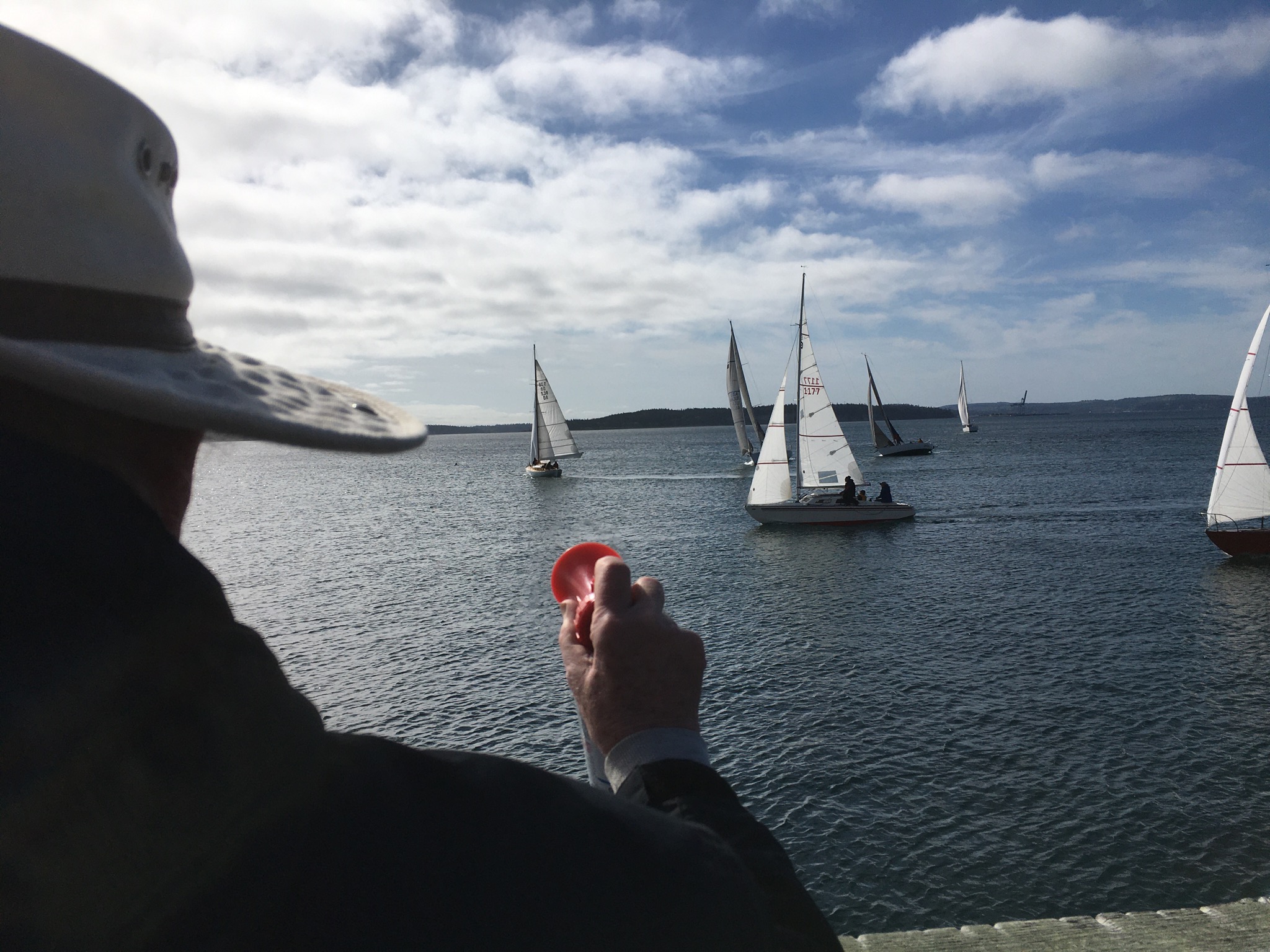
Last Friday’s race was relatively long (5.39nm) course which included dock to trestle mark to tower to #2 buoy to finish at dock. Starting time was 18:05:00 and 11 boats participated.
Perhaps to start a conversation, here’s a column from the June, 2010, issue of Sailing World on varying the racecourses beyond windward – leeward. What do you think? There’s a poll at the bottom you can enter your opinion. Jon
=================================
Are the sailors in your fleet tired of sailing around the same old racecourses year after year? If so, inject some excitement into your races with a few easy ideas. From the “Jobson Report” from our June 2010 issue
It’s much different nowadays, because we’ve come to expect perfectly aligned windward-leeward courses, but it seems sailors are growing tired of the same-old, and it’s time for race committees and sailors to branch out and try new course configurations, or, in some cases, revive a few old traditions.
by Gary Jobson
I’ll never forget my very first sailboat race. I was six years old at the time, and my responsibilities on the 15-foot, gaff-rigged Sneakbox included bailing out the leaky boat and holding on to our paper chart, which had the racecourse outlined on it. At the first mark we led the fleet, and I had the boat completely dry. But when the skipper asked what the next mark of the course was, I couldn’t say. The chart had fallen out of my pocket and was now floating on New Jersey’s Barnegat Bay. We eventually lost our lead, and the race, and since then I’ve made it a point to know the correct course to sail.
As I reflect on those early days, I fondly remember how the racecourses were always set around a collection of buoys scattered around the Bay. The race committee usually tried to set a course that featured all points of sail. It was unpredictable and always great fun.
Thanks to Elizabeth Becker for some great shots from the PTSA sponsored 6 Meter (or is it Metre?) NA’s.
Great shots, great boats. More photos coming soon.
2010 North American Six Meter Championships
August 13 – 15, 2010
Port Townsend, WA.
Conditions: Sunny and Hot, 7 races, no throw outs, 8 – 10 knots both days.
Boat
Owner
Sail #
Total
Place
Place
Place
-1-
-2-
-3-
-4-
-5-
-6-
-7-
NA's
Modern
Classic
Arunga
Cadranellus
US 118
1
2
1
6
1
1
1
13
1ST
1ST
Finnegan
Parker
US 123
3
1
2
1
3
2
5
17
2ND
2ND
Saskia II
Muller
KC 19
5
3
4
2
4
6
4
28
3RD
1ST
Frenzy
Phillips
US 107
6
4
5
5
2
4
3
29
3RD
Flapper
Booth
N 71
4
5
3
3
5
3
6
29
2ND
Gallant
Jespersen
KC 10
2
6
6
4
6
5
2
31
3RD
Lulu
Downey
US 72
7
7
8
7
7
8
7
51
Sockeye
Mitchell
US 119
8
8
7
8
8
7
8
54
The 2010 North Americans took place over the weekend of August 14 -15 in Port Townsend, WA. To say the conditions were excellent would be an understatement, with consistent 8 – 10 knots for the 7 races under clear blue skies and warm temperatures. The event opened on Friday evening with a reception at the Port Townsend Foundry courtesy of Pete Langley. On Saturday the Olympic Mountains to the west were clear as were the Cascade Mountains to the east. The races were 5 – 9 miles long on the western end of Quimper Bay with shifts of 5 – 10 degrees making things interesting for the competitors. Tidal currents were present, though not extreme. In the Moderns it was Andy Parker and Finnegan leading after the first 4 races, with Rainer Muller’s Saskia II (Olympic medallist Ross MacDonald driving) carrying a 1 point lead over Nick Booth’s Flapper. The 2009 World Cup winners, KC 10 Gallant, had a tough start to the regatta with an over early in the second race and then hitting the mark while in the lead in the 3rd.
Thanks Sym for these pictures of Saturday’s party and Sunday’s
light wind start.
We could not have planned a better weather weekend, hot and sunny both days. On Saturday we got our downwind spinnaker run shortly after the start, and were able to keep them up almost the entire day. There were some holes to be found but Thatuna did a remarkable job of staying in the breeze and drove around the entire fleet. Saturday finished with Sea Puppy, an F 24 tri from Sequim being single handed all weekend by Bruce von Borstel crossing first, followed by Frank Lawson’s sharp J/105, john B, from Port Ludlow, and the Thatuna.
The barge had been reserved and stocked with pizza. Add some adult beverages, a lovely summer evening in Port Ludlow and it was hard to beat. A special thanx goes out to Sym Sebastian for putting together a great barge party, safe to say all had a good time there…
Sunday looked dismal for wind with a forecast of 3 building to 6. But as the race started in front of Port Ludlow we were given nice, fairly constant pressure. At the same time the slack disappeared and the ebb began to build.