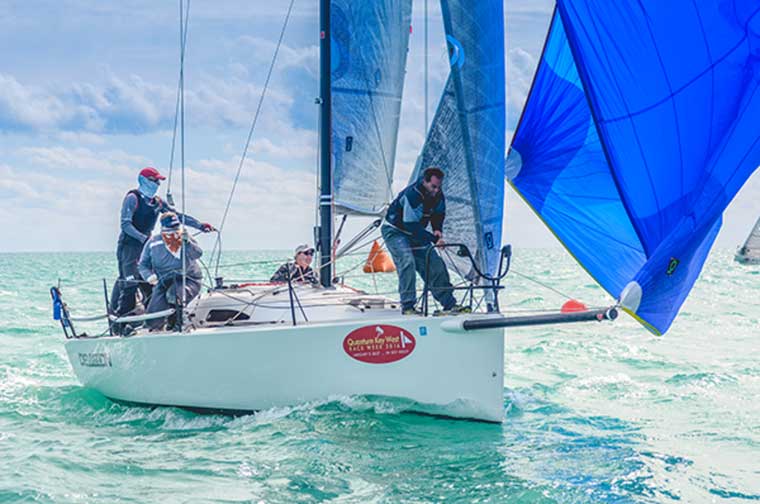
Busy sailing weekend ahead The series that was too fun to stop continues Friday. The six race White Cap Series had a possible make up race scheduled for this Friday. All six races were run, the series scored and completed, but no one could think of a reason not to have a race this Friday (May 17). Look for a dock start.
Over 20 multihulls, from hot little Weta tri's to the Formula 40, DRAGON, are scheduled to be racing in PT this weekend. A number of them are looking for crew for a Protection Island race on Saturday, and in-shore bay races on Sunday. The skipper's meeting will be at 8 AM on Saturday under the marina facing porch by the Shanghai and Pt Hudson Cafe. If you'd like to crew, that's where you should be, too.
|
A post from UK Sailmakers reminds us that, especially in light air, limiting your mistakes is the key.
Fewer mistakes are the key to victory in sailboat racing.
By Adam Loory, General Manager of UK Sailmakers International
Last Thursday I re-learned the adage that to win sailboat races, you need to make fewer [...]
The upcoming Shipwright’s Regatta is the start of the often windy spring sailing season. With rusty skills we may be heading out into challenging conditions. Before we untie from the dock it just makes good sense to check safety equipment, put on our PFD’s and review rescue procedures. Below is a post from the Royal Ocean Racing Club’s website that goes over some of the key elements in a successful crew overboard rescue.
When a crew member goes over the side recovery time is of the essence. In an effort to come up with a recovery system that is simple and lightning quick, the US Yacht Racing Union Safety at Sea Committee, the US Naval Academy Sailing Squadron, the Cruising Club of America Technical Committee and the Sailing Foundation of Seattle, Washington, joined forces to conduct extensive research and sea trials. The result of their collaboration is the “Quick-Stop” method of man-overboard recovery. The hallmark of this method is the immediate reduction of boat speed by turning in a direction to windward and thereafter maneuvering at modest speed, remaining near the victim. In most instances, this is superior to the conventional procedure of reaching off, then either gibing or tacking and returning on a reciprocal course.
QUICK-STOP
1. Shout “man overboard” on the wind and designate a crew member to spot and point to the victim1s position in the water. The spotter should not take his eyes off the victim (see Figure 1 below).
2. Provide immediate flotation. Throw buoyant objects such as cockpit cushions, life rings and so on. These objects may not only come to the aid of the victim, but will “litter the water” where he went overboard and help your spotter to keep him in view. Deployment of the pole and flag (dan buoy) requires too much time. The pole is saved to “put on top” of the victim in case the initial manoeuvre is unsuccessful.
continue reading » Crew Overboard Rescue With Life Sling
A good race tip from Sailing World

1. As he approaches the leeward mark, Lindberg intentionally slows in order to exit the mark in the high lane—a textbook wide-then-tight rounding. Presti, meanwhile, knowing he wants to tack around the mark, doesn’t worry about having his bow below the transom of Lindberg. Presti’s crew drops the spinnaker early enough so that everyone is in their positions and able to trim the sails during the rounding. Presti and his team enter the rounding with a powerful setup: the genoa is eased, the main is coming in early to help turn the boat, and they trim the sails for maximum speed as they round. Keeping the main slightly over trimmed in respect to the boat’s angle, and keeping the genoa slightly undertrimmed, helps the boat turn without too much rudder movement, which will slow the boat.
continue reading » Passing at the Leeward Mark
Click for bigger image
Light air and strong current are tricky conditions and as the results of last Sunday’s race show, trickier for some boats then others. Besides reading the current and the wind, light and varying conditions call for almost continuous shifting gears to maintain good boat speed. Here’s Greg Fisher’s take [...]
|
|